
OEKO-TEX® vs GOTS: What Do Activewear Certifications Actually Mean?
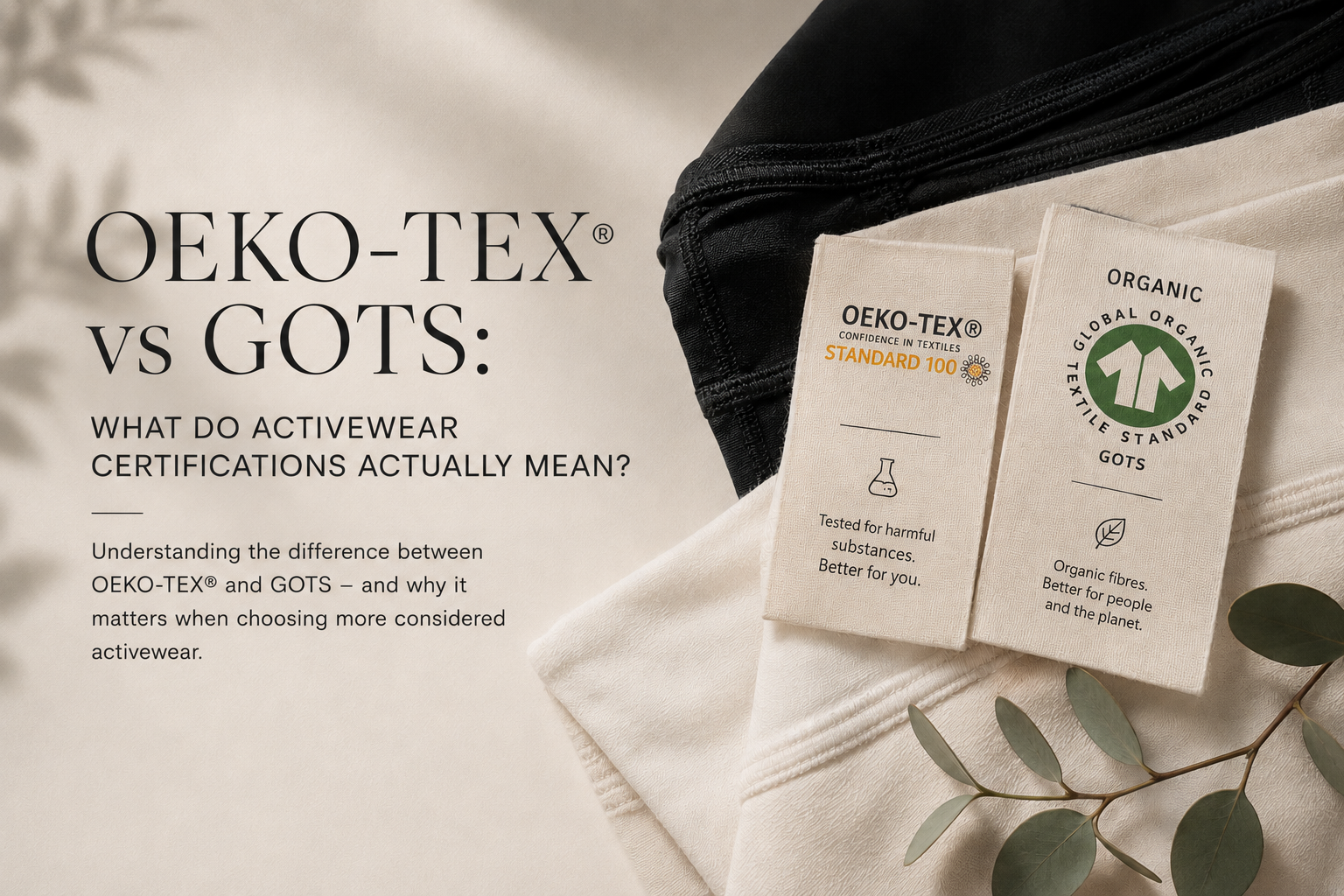
OEKO-TEX® and GOTS are two of the most recognised textile certifications, but they don't mean the same thing. OEKO-TEX® STANDARD 100 focuses on testing textiles for substances that may be harmful to human health, while GOTS is an organic textile standard covering certified organic fibres alongside environmental, chemical and social requirements throughout textile processing.
If you're trying to make more considered choices about your activewear, you've probably come across both.
OEKO-TEX® certified. GOTS certified. Organic. Low-tox. Natural fibres.
There are a lot of terms to navigate, and it's not always obvious what they actually tell you about the clothing you're buying.
At KEAN, we're increasingly looking at recognised textile certifications as part of our approach to creating more considered performance and loungewear.
But we also think it's important to explain what those certifications actually mean.
So, what's the difference between OEKO-TEX® and GOTS, and is one better than the other?
The short answer is: they measure different things.
What Is OEKO-TEX® STANDARD 100?
OEKO-TEX® STANDARD 100 is an internationally recognised certification for textiles that have been tested against a comprehensive set of substances that may be harmful to human health.
Testing can apply across the components of a certified textile product, and the requirements become more stringent depending on how closely the textile is intended to come into contact with the skin.
That's particularly relevant for activewear.
Sports bras, leggings and training shorts are often fitted closely against the body and worn while we're exercising, sweating and moving.
OEKO-TEX® certification gives consumers another piece of information about the textile beyond how it looks, feels or performs.
However, there's an important distinction:
OEKO-TEX® does not mean organic.
A textile made from synthetic fibres such as nylon or polyester can still meet the requirements of OEKO-TEX® STANDARD 100.
What Is GOTS?
GOTS stands for the Global Organic Textile Standard.
It's a globally recognised textile processing standard for products made from certified organic natural fibres.
But GOTS goes beyond simply verifying that cotton was organically grown.
The standard includes requirements covering textile processing, environmental criteria, chemical inputs and social criteria throughout certified stages of the supply chain.
This makes GOTS particularly relevant when you're looking for clothing made from organic natural fibres such as cotton.
At KEAN, you'll find GOTS-certified organic cotton within our Recovery Collection and our upcoming Core Collection.
OEKO-TEX® vs GOTS: What's the Main Difference?
The easiest way to understand the difference is that the two certifications answer different questions.
OEKO-TEX® STANDARD 100 asks:
Has this textile been tested against a wide range of substances that may be harmful to human health?
GOTS asks:
Is this textile made using certified organic natural fibres and processed according to defined environmental, chemical and social criteria?
That means a fabric can potentially be OEKO-TEX® certified without being organic.
Likewise, seeing the word "organic" on a garment doesn't automatically tell you everything about how the fibre was processed.
This is why understanding the actual certification behind a claim matters.
OEKO-TEX® vs GOTS at a Glance
| OEKO-TEX® STANDARD 100 | GOTS | |
|---|---|---|
| Main focus | Testing for harmful substances | Organic textile processing |
| Requires organic fibres | No | Yes |
| Can apply to synthetic textiles | Yes | GOTS products are based on certified organic natural fibres, with certification rules governing permitted additional fibres |
| Chemical criteria | Yes | Yes |
| Environmental processing criteria | Not its primary purpose | Yes |
| Social criteria | Not the primary focus of STANDARD 100 | Yes |
| Relevant to technical activewear | Yes | Potentially, depending on composition and certification |
| Relevant to organic cotton clothing | Yes, if separately certified | Yes |
The important takeaway is that OEKO-TEX® and GOTS aren't interchangeable certifications.
And one isn't automatically "better" than the other.
It depends on what you're trying to understand about the textile.
Does OEKO-TEX® Mean Non-Toxic?
We prefer not to describe OEKO-TEX® certified clothing as completely "non-toxic" or "chemical-free".
Textile manufacturing is complex and chemistry is involved at many stages of creating fabric, including dyeing and finishing.
OEKO-TEX® STANDARD 100 provides something much more specific and useful: a recognised testing standard covering a wide range of substances that may be harmful to human health.
That's why at KEAN, we talk about OEKO-TEX® as part of our broader approach to low-tox activewear, rather than using it to make absolute claims.
Does GOTS Mean Chemical-Free?
No.
This is another important distinction.
GOTS certification doesn't mean no chemicals are involved in turning organic cotton into finished fabric.
Instead, GOTS sets requirements and restrictions around the inputs and processes that can be used throughout certified textile processing.
So when you see GOTS-certified organic cotton, you're getting considerably more information than simply seeing the word "cotton" or even "organic cotton" on a label.
Is GOTS Better Than OEKO-TEX®?
Not necessarily.
They serve different purposes.
If your priority is organic natural-fibre content, GOTS is particularly relevant because certified organic fibres sit at the heart of the standard.
If you're looking at a technical synthetic performance fabric, OEKO-TEX® STANDARD 100 can provide relevant information about testing for harmful substances even though the textile itself isn't organic.
This distinction is particularly useful in activewear because different types of movement require very different things from fabric.
Why Does KEAN Use OEKO-TEX®?
The fabric used in the KEAN Edge Collection is OEKO-TEX® certified.
Edge is designed as technical performance activewear, where properties such as stretch, compression, support and shape retention matter.
That requires technical fibres.
Instead of pretending we can currently achieve every one of those properties with natural fibres, we've chosen an OEKO-TEX® certified technical fabric for Edge.
It allows us to retain the performance characteristics we need while making a more considered fabric choice.
It's also important to be transparent that not every KEAN activewear product is OEKO-TEX® certified.
KEAN has other existing performance garments made from different technical fabrics that don't carry this certification. Where a KEAN product uses an OEKO-TEX® certified fabric, we'll clearly identify it.
Learn more about OEKO-TEX® certified Edge activewear →
Why Does KEAN Use GOTS-Certified Organic Cotton?
There are other moments when we simply don't need the same level of technical performance.
That's where natural fibres can play a much bigger role.
Our KEAN Recovery Collection is made from 100% GOTS-certified organic cotton.
Recovery is designed for rest days, travel, walking, slow mornings and the hours before, after and between workouts.
Because those garments don't require technical compression or significant stretch, we're able to remove synthetic performance fibres from the fabric composition completely.
What About Organic Cotton Activewear?
This is where things get particularly interesting for us.
Our upcoming KEAN Core Collection is being developed for low-to-moderate intensity movement using 95% GOTS-certified organic cotton and 5% spandex.
The small amount of spandex provides the stretch and recovery needed from fitted activewear while allowing organic cotton to make up the vast majority of the fabric composition.
Core is designed for activities such as:
-
Pilates
-
walking
-
barre
-
mobility
-
stretching
-
low-to-moderate intensity strength training
-
everyday movement
It creates a middle ground between technical performance activewear and 100% organic cotton recovery wear.
Why Doesn't KEAN Just Use Organic Cotton for Everything?
Because we believe fabric should be chosen based on what the garment actually needs to do.
A relaxed sweatshirt doesn't need 30% elastane.
But a high-support sports bra can't necessarily provide the stretch, support and shape recovery required from 100% cotton.
That's why we're moving towards a more purposeful approach.
Performance: technical fibres where their functionality is genuinely needed.
Edge: OEKO-TEX® certified technical performance fabric.
Core: 95% GOTS-certified organic cotton with 5% spandex for low-to-moderate intensity movement.
Recovery: 100% GOTS-certified organic cotton when technical stretch isn't required.
Rather than labelling one material "good" and another "bad", we're interested in using the right material for the right purpose.
Learn more about KEAN fabrics and our approach to low-tox activewear →
What Should You Look for When Buying More Considered Activewear?
Start by looking beyond the claims on the front of the website.
Ask:
What is the garment actually made from?
Look for a clear fibre composition rather than vague language around sustainability or wellness.
Does it carry a recognised textile certification?
Look for certifications such as OEKO-TEX® or GOTS and understand what that particular certification actually covers.
Does the fabric make sense for its purpose?
A high-performance garment has very different requirements from something designed for walking or lounging.
Is the brand transparent?
No fabric is perfect. Brands should be willing to tell you what their clothing contains and why they've chosen it.
For us, transparency is just as important as the fabric itself.
Frequently Asked Questions
What is the difference between OEKO-TEX® and GOTS?
OEKO-TEX® STANDARD 100 focuses on testing textiles against a wide range of substances that may be harmful to human health. GOTS is an organic textile processing standard covering certified organic fibres along with environmental, chemical and social requirements.
Is OEKO-TEX® organic?
No. OEKO-TEX® certified textiles can be made from natural or synthetic fibres. The certification does not mean the fibre itself is organic.
Is GOTS organic?
GOTS is specifically designed for textiles made using certified organic natural fibres. The standard also covers processing requirements beyond the cultivation of the original fibre.
Is OEKO-TEX® better than GOTS?
Neither certification is universally better. They focus on different aspects of textile production and can therefore be useful for different types of clothing.
Can synthetic activewear be OEKO-TEX® certified?
Yes. Synthetic textiles such as nylon and polyester can meet OEKO-TEX® STANDARD 100 requirements. KEAN's Edge Collection, for example, uses an OEKO-TEX® certified technical performance fabric.
Is all KEAN activewear OEKO-TEX® certified?
No. OEKO-TEX® certification currently applies to the fabric used in our Edge Collection, not every KEAN activewear product. Applicable certifications are identified on individual product pages.
Does KEAN use GOTS-certified organic cotton?
Yes. KEAN Recovery uses 100% GOTS-certified organic cotton, while our upcoming Core Collection uses 95% GOTS-certified organic cotton with 5% spandex.
What does KEAN mean by low-tox activewear?
Low-tox activewear isn't a regulated certification. At KEAN, we use the term to describe our approach to making more considered fabric choices, seeking recognised textile certifications, increasing fabric transparency and reducing our reliance on synthetic fibres where garment performance allows.
Certifications Are One Part of the Picture
There isn't one certification that tells you everything about a garment.
And there isn't one perfect fabric for every type of movement.
That's why we think understanding what certifications actually mean is more useful than simply looking for a logo on a label.
At KEAN, our fabric journey is evolving.
We're using OEKO-TEX® certified technical fabric where performance requires it within Edge.
We're introducing predominantly natural-fibre activewear through Core.
And we're using 100% GOTS-certified organic cotton where technical fibres aren't required through Recovery.
We're not claiming perfection.
We're simply asking more questions, being more transparent and making more considered choices with every collection we create.
Because what you wear matters. And understanding what it's made from should be easier.